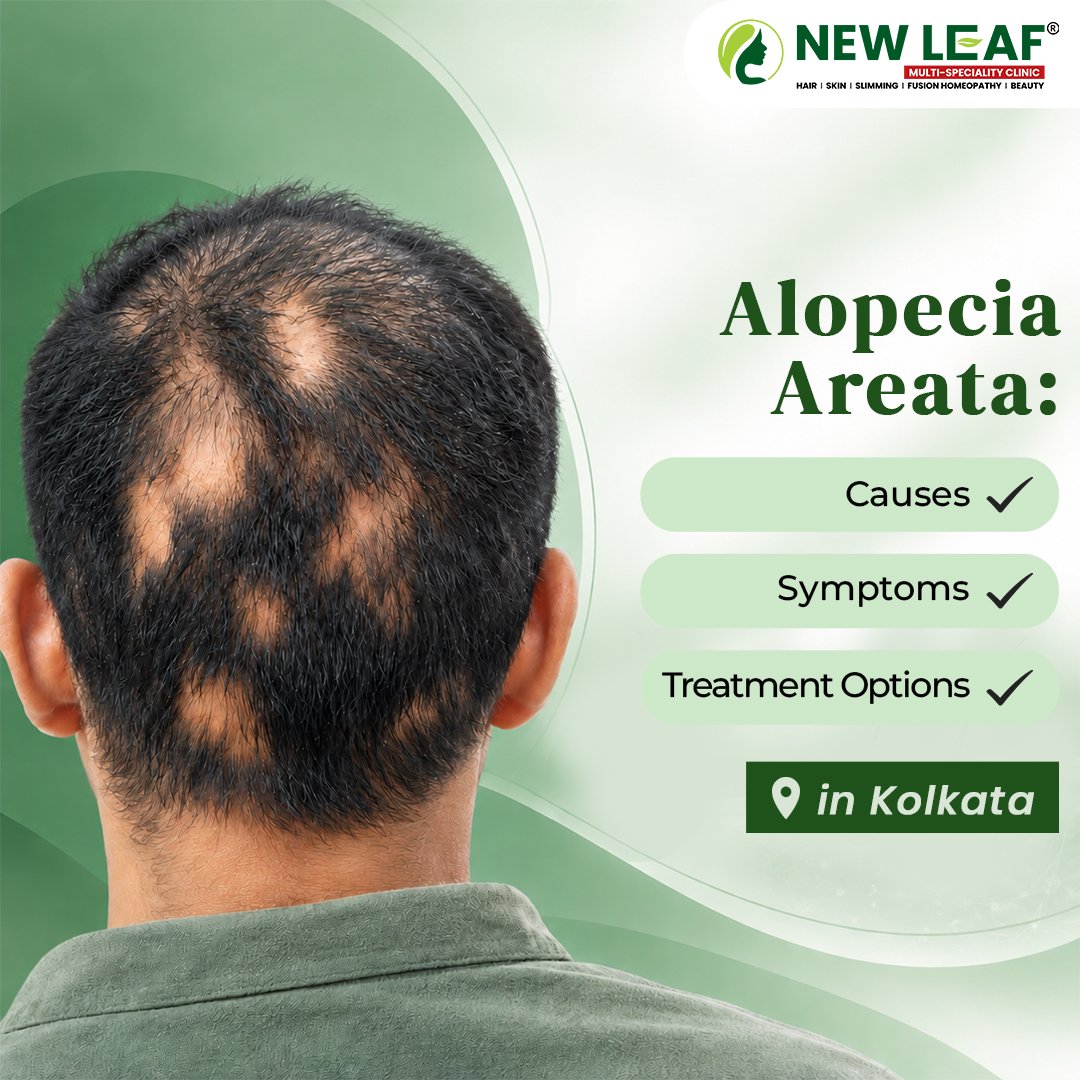
You notice a smooth, coin-sized patch on your scalp while combing your hair. No itching, no flaking, nothing that hurt. Just… hair, gone, overnight it seems. That’s usually how alopecia areata shows up, and it’s more common in Kolkata than most people realize — we see it walk through our doors every week, often on people who assumed it was stress-related hair fall until the patch stayed perfectly round and perfectly bald.
Alopecia areata isn’t hair fall in the usual sense. It’s an autoimmune condition, and understanding that difference changes how you should treat it.
What Is Alopecia Areata, Exactly?
Alopecia areata happens when your immune system mistakes hair follicles for something foreign and attacks them. The follicles don’t die — they just get shut down, which is the one piece of good news in this whole condition. Since the follicle survives, hair can come back, sometimes on its own, sometimes with treatment.
This is different from androgenetic alopecia (the pattern baldness that thins hair gradually over years) and different from telogen effluvium (the diffuse shedding you get after fever, surgery, or a crash diet). Alopecia areata tends to be sudden, patchy, and oddly precise — you’ll often see one or two clean, round bald spots rather than general thinning.
In rarer cases it progresses to alopecia totalis (complete scalp hair loss) or alopecia universalis (loss of all body hair). Most patients we see never get anywhere close to that. A single patch, sometimes two, is the far more typical presentation.
Why Does It Happen?
Doctors still don’t have one clean answer. What we do know:
Genetics plays a real role. Family history is common — if a parent or sibling has had alopecia areata, your odds go up noticeably, especially if the condition started before age 30.
Autoimmune connections matter too. People with thyroid disorders, vitiligo, or other autoimmune conditions show up with alopecia areata more often than the general population. That’s why, during your first consultation, we usually ask about your broader health history — not just your scalp.
Stress gets blamed constantly, and it’s not entirely wrong, but it’s not the whole story either. A major stressful event can act as a trigger in someone who was already genetically primed for it. It’s rarely the sole cause, whatever your relatives keep insisting at the dinner table.
Recognizing the Symptoms
Here’s what actually brings people into our clinic:
- One or more smooth, round patches of hair loss on the scalp, usually painless
- Occasional mild tingling or itching right before a patch appears — not everyone gets this
- Hair loss in eyebrows, eyelashes, or beard, sometimes without any scalp involvement at all
- Nails that look pitted, ridged, or unusually brittle — an underrecognized sign that’s easy to miss if nobody’s looking for it
- “Exclamation mark” hairs at the edge of a patch — short strands that are thinner near the scalp than at the tip
If you’re seeing a patch with a rough or scaly surface, that’s usually not alopecia areata — it points toward a fungal infection instead, and it needs a different treatment altogether. This is exactly why a proper diagnosis matters before you start applying anything to your scalp.
Getting Diagnosed
Most of the time, diagnosis is straightforward on examination — a dermatologist can identify the classic patch pattern and exclamation-mark hairs without much fuss. When the picture isn’t clear, we might do a trichoscopy (a magnified scalp exam) or, rarely, a small biopsy. Blood tests to check thyroid function are common too, given how often the two conditions travel together.
Treatment Options We Use in Kolkata
There’s no permanent cure for alopecia areata — anyone promising you a one-time fix is overselling it. What treatment does is calm the immune attack and give follicles a chance to restart. Options vary by how much hair is involved and how fast it’s spreading.
Intralesional corticosteroid injections. For localized patches, this is usually the first line. Small injections directly into the bald area suppress the local immune response. Regrowth often starts within 4 to 8 weeks, though it needs repeat sessions roughly every month.
Topical corticosteroids and minoxidil. Creams or solutions applied at home, sometimes combined for better response. Minoxidil alone won’t stop the autoimmune attack, but it helps stimulate regrowth once the attack settles.
Topical immunotherapy. For more stubborn or widespread patches, we sometimes use agents like DPCP, which deliberately provoke a mild allergic reaction on the scalp to redirect the immune system’s attention. It sounds counterintuitive, and honestly the first time we explain this to a patient they usually look at us sideways — but it has a solid track record for harder cases.
Oral treatments. For extensive or rapidly progressing alopecia areata, oral corticosteroids or newer JAK inhibitors may be considered. These are more involved decisions, and we walk through the trade-offs — including monitoring requirements — case by case.
PRP therapy. Platelet-rich plasma injections are gaining ground as a supportive option alongside the treatments above, particularly for patients who want to combine approaches. It’s not a standalone cure, but it can support follicle recovery when layered into a broader plan.
What we tell every patient upfront: response takes weeks, not days. Somewhere between 4 to 8 weeks before you see fuzz, longer before it fills in properly. Patience is genuinely part of the treatment.
Will It Come Back Later?
Sometimes, yes. Alopecia areata can relapse, and that’s not a sign your treatment failed — it’s simply how this condition tends to behave for a subset of patients. What helps is catching a recurrence early, before a new patch grows into several. If you’ve had it once, keep an eye on your scalp and come in at the first sign of a new spot rather than waiting to see if it resolves alone.
GFC vs PRP for Alopecia Areata — A Quick Note
Patients researching hair regrowth options in Kolkata often come across GFC (Growth Factor Concentrate) alongside PRP and ask which one applies to alopecia areata specifically. Short answer: both can support follicle recovery once the immune flare is under control, but neither replaces the corticosteroid or immunotherapy step for an active autoimmune patch. If you’re comparing the two for your specific case, it’s worth a dedicated conversation with your dermatologist rather than picking based on marketing claims.
When to See a Dermatologist
Don’t wait on a bald patch hoping it resolves by itself, and don’t reach for random “hair growth oils” from the pharmacy before you know what you’re dealing with. Sudden, well-defined hair loss deserves a proper look — partly because early intervention genuinely improves outcomes, and partly because a handful of other conditions can mimic alopecia areata’s early signs.
If you’ve spotted a patch, book a consultation. We’ll examine the scalp, check for related conditions, and put together a treatment plan built around how your case is actually presenting — not a generic protocol pulled off a shelf.