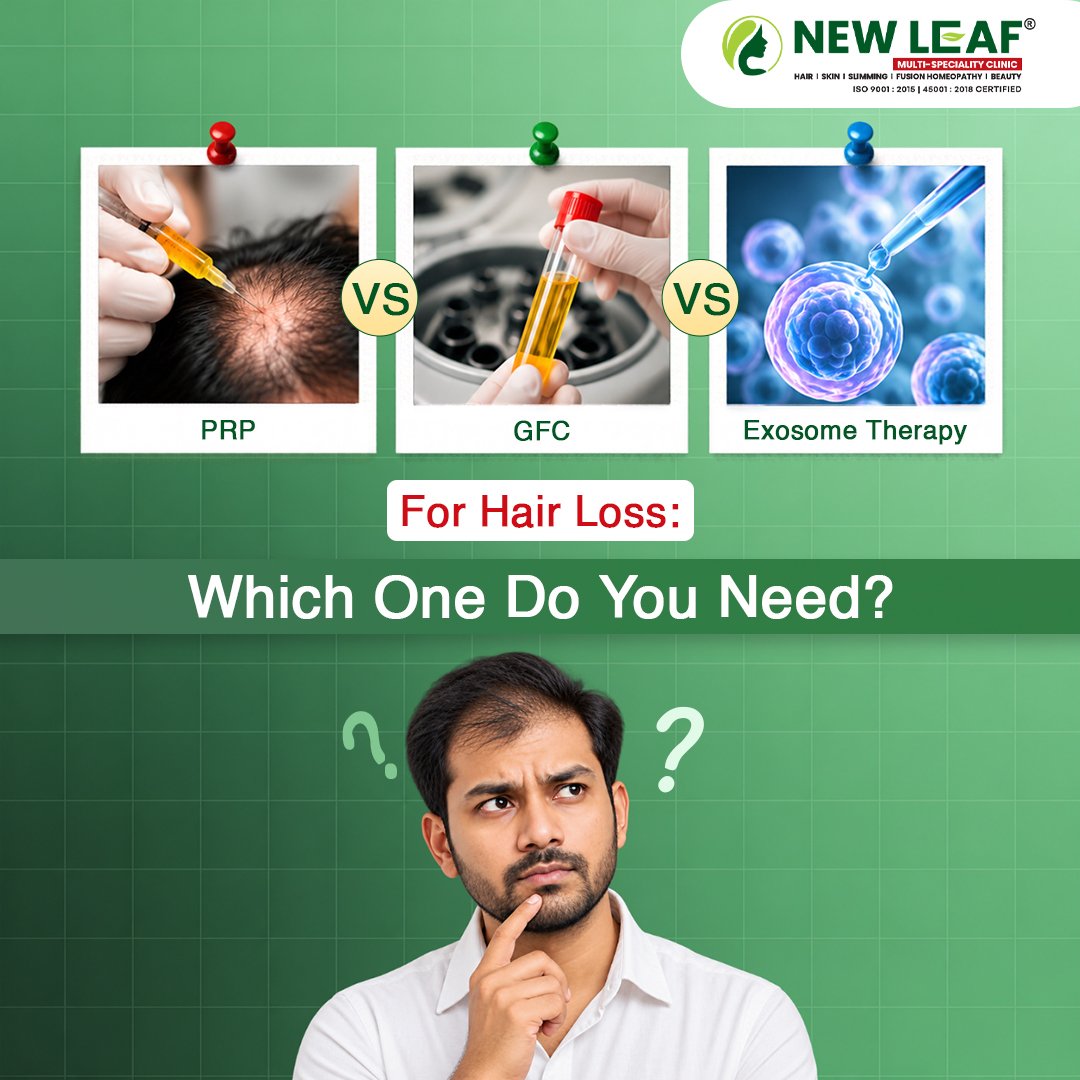
The short answer
If your hair is thinning but there’s still hair in the area, PRP is the safest place to start. It uses your own blood and has the most research behind it of the three.
GFC is a refined version of PRP. It’s also made from your blood, but processed to keep the growth factors and leave most of the rest behind, so many patients find the injections more comfortable. Exosome therapy is the newest. Early results look encouraging, but the research is still thin and product quality varies between brands, so we suggest it only after a consultation, never as a first step.
One thing none of them can do: regrow hair where the follicles are already gone. For a smooth, shiny bald area, a transplant is the realistic option (our guide to hair transplant cost in Kolkata explains what that involves).
| PRP | GFC | Exosome therapy | |
|---|---|---|---|
| Made from | Your own blood | Your own blood | A ready-made product, not from your body |
| How it’s prepared | Blood is spun in a centrifuge and the platelet-rich layer is collected | Blood is processed to release and concentrate the growth factors | Supplied in vials by a manufacturer |
| Research behind it | The most of the three | Less than PRP | Early, mostly small studies |
| Comfort | Some scalp soreness for a day or two | Usually milder than PRP | Usually mild |
| Typical course | Usually 3 to 4 sessions about a month apart, then maintenance | Set by your doctor, often similar to PRP | Usually 1 to 3 sessions, a month or more apart |
| Best suited to | Early to moderate thinning | Early to moderate thinning, or people who found PRP uncomfortable | Selected cases, after a doctor’s assessment |
How PRP, GFC and exosome therapy work
PRP (platelet-rich plasma)
We draw a small amount of your blood, much like a routine blood test, and spin it in a centrifuge. The platelets settle into a concentrated layer. That layer goes into the thinning areas of your scalp through fine injections or microneedling.
Why platelets? They carry growth factors, proteins that signal cells to repair and grow. Placed around weak follicles, they can push more of them into the growth phase and thicken thin, wispy hairs. It’s slow work. You won’t wake up with new hair after one session.
GFC (growth factor concentrate)
GFC starts the same way, with your own blood. The difference is in the processing. Special tubes trigger the platelets to release their growth factors, and that concentrate is separated from the red and white blood cells. What goes into your scalp is cleaner and more concentrated.
Patients usually notice two things: the injections sting less, and there’s less swelling afterwards. Is GFC more effective than PRP? Some clinics say so. The research comparing the two directly is small, though, so we present GFC as a more comfortable option, not a guaranteed upgrade.
Exosome therapy
Exosomes are tiny packets that cells release to send signals to other cells. The ones used for hair are produced in a lab, usually from stem cell cultures, and arrive as a ready-made product. Nothing is drawn from your body.
Lab studies are promising. Exosomes appear to wake up resting follicles and calm scalp inflammation. Human studies are fewer and smaller. A 2026 review of exosome treatments in India found that clinics have adopted them faster than the evidence and the regulations have kept up. So ask any clinic offering exosomes what the product is, who makes it and what approvals it has.
Which treatment fits your kind of hair loss?
- Early thinning, a widening parting, or a crown that’s starting to show. PRP or GFC, alongside the medicines your doctor prescribes. This is where these treatments do their best work, because there are plenty of weak follicles left to strengthen.
- You’ve had PRP before and found it painful. Ask about GFC. The process is similar, and most people find it easier to sit through.
- Sudden shedding after an illness, stress or a crash diet. This often settles once the cause is sorted. Finding the cause comes first, usually with blood tests for iron, thyroid and vitamin D. PRP can help some people recover faster.
- Round, smooth bald patches (alopecia areata). This is a different problem: the immune system is attacking the follicles. Steroid injections are usually the first treatment, and PRP is sometimes added. Our alopecia areata guide covers this in detail.
- Smooth, shiny bald areas. None of the three will bring hair back here. A transplant is the realistic route.
- Exosomes. We’d consider them when PRP or GFC haven’t given the result you hoped for, or when drawing blood isn’t practical for you. Always after an honest talk about what the evidence does and doesn’t show.
They work best as part of a plan
PRP, GFC and exosomes are add-ons, not replacements for medical treatment. For pattern hair loss, the treatments with the strongest evidence are still topical minoxidil and, for men, oral finasteride, which needs a prescription. Most people get the best results when an injectable treatment is combined with medicines and good scalp care.
Scalp care matters more than people think. Dandruff and an oily, inflamed scalp (seborrhoeic dermatitis) can make hair fall worse. We often treat that first, so the scalp is healthy before injections start.
Who should skip PRP and GFC
- People with a low platelet count or a blood-clotting disorder
- People on blood thinners (tell your doctor, and don’t stop any medicine on your own)
- Anyone with an active scalp infection or open wounds on the scalp
- Pregnant or breastfeeding women, for whom treatment is usually postponed
- People with active cancer or undergoing chemotherapy
What a session is like
- Consultation and photos. The doctor examines your scalp, confirms the type of hair loss and takes photos so progress can be compared later.
- Blood draw (PRP and GFC only). A small sample is taken from your arm and processed while you wait.
- Preparation. Your scalp is cleaned, and numbing cream is applied if you need it.
- Treatment. The concentrate, or the exosome product, goes into the thinning areas through fine injections or microneedling.
- Afterwards. Your scalp may feel sore or tight for a day or two. Your doctor will usually ask you not to wash your hair the same day, and to skip hair colour, steam and heavy workouts for a short while.
Start to finish, a visit usually takes under an hour.
When will you see results?
Patience is the hard part. Here’s a realistic timeline:
- First 1 to 2 months: hair fall usually slows down. This is the first sign it’s working.
- Around 3 months: fine new hairs appear, and existing hair feels thicker.
- Around 6 months: the fair point to judge results, comparing your photos from day one.
Pattern hair loss doesn’t stop on its own, so the results need upkeep. Most people need a maintenance session every few months, as their doctor advises. Stop completely, and the gains fade over time.
Frequently asked questions
Is PRP painful?
You’ll feel the injections, a series of quick pricks. Numbing cream takes the edge off, and most people describe it as uncomfortable rather than painful. GFC is usually milder.
Is PRP or GFC better for hair loss?
Both come from your own blood and work in a similar way. PRP has more research behind it. GFC is often more comfortable. Your doctor will suggest one based on your scalp, your hair loss and how you handled any earlier treatment.
How many PRP sessions do I need?
Usually 3 to 4 sessions about a month apart to start, then maintenance sessions every few months.
Does PRP work for women?
Yes. Female pattern thinning, where the parting widens and the ponytail gets thinner, responds to PRP in a similar way. The cause should be checked first, because thyroid problems, low iron and PCOS are common in women with thinning hair.
Is exosome therapy safe?
Reported side effects so far are mild, mostly redness and soreness. The bigger question is quality, because products vary and regulation in India is still catching up. Ask exactly which product will be used.
Can I have PRP after a hair transplant?
Yes. Many surgeons use PRP or GFC after a transplant to support healing and growth of the new grafts.
Not sure which treatment fits your hair loss? Book a scalp consultation at New Leaf Multi-Speciality Clinic, 1st floor, 54 Ekdalia Road (above HDFC Bank), Ballygunge, Kolkata 700019. [CONFIRM: phone number and booking link]
Publishing notes (not part of the post)
| Field | Value |
|---|---|
| Meta title | PRP vs GFC vs Exosome Therapy for Hair Loss | New Leaf Kolkata |
| Meta description | PRP, GFC or exosome therapy? How each works, which suits your hair loss, sessions and results. From New Leaf Clinic, Ballygunge, Kolkata. |
| URL slug | /prp-vs-gfc-vs-exosome-therapy-hair-loss-kolkata |
| Primary keyword | prp treatment in kolkata |
| Secondary keywords | prp therapy, gfc hair treatment, exosome therapy for hair kolkata, cheap prp hair treatment |
Internal links to add
- “guide to hair transplant cost in Kolkata” → your Hair Transplant Cost in Kolkata post
- “Our alopecia areata guide” → your Alopecia Areata post
- Link “PRP” and “GFC” once each to your service pages, if you have them [CONFIRM URLs]
Before publishing
- Fill or delete every [CONFIRM] note
- Have the treating doctor read it, and add their name and qualifications as reviewer
Sources behind the medical claims